
Protecting Europe’s largest owl
In connection with the development and construction of the Kraśnik Wind Farm in Lubelskie, Poland, OX2 has taken the initiative to protect Europe’s largest owl, the bubo bubo.
The Lublin Voivodeship is one of the last refuges of the eagle owl (bubo bubo) in Poland, which is considered an extremely rare breeding bird in Poland. OX2 has taken the initiative to protect the large eagle owl in cooperation with the Foundation for Nature. The project aims to learn about the state of the population and to take action to avoid further decline.
A rare species in decline
The trend of declining biodiversity is reflected in the bubo bubo population, which has also been shrinking. Although the population status is not fully known, it has been noted that this highly skittish species are struggling with habitat loss and food scarcity.
Action to halt further decline
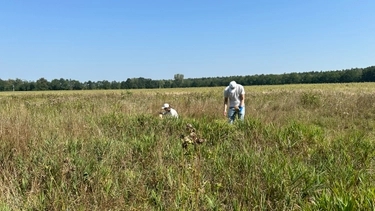
The project aims to determine the current status of the Bubo bubo owl population in the Lublin region, expand knowledge about it, and use this knowledge to halt its further decline. Research has been based on surveys using audio recorders, drones with thermal imaging cameras as well as analyzing historical data and maps.

The increased knowledge arising from this research has been used to define protection zones and determined areas with high potential for settlement. The project has also installed artificial nesting sites in suitable locations.
The collected material provides a solid basis for planning a long-term strategy for the protection of eagle owls on a regional and national scale, and the methodology developed can be successfully transferred to other forest complexes in Poland.
Project facts
- The activities covered a total area of approx. 2,400 km2 (60 km x 40 km)
- Over 350 hours was spent in the field and covered an area over 500 km
- 9 audio recorders was used for listening, the devices operated in 70 locations, generating approximately 6,000 hours of recordings
- The material underwent a two-stage analysis: filtering with the BirdNET algorithm and manual verification of positive indications
- Results from the project was presented at one of the most important conferences on the impact of wind farms on birds organized in Poland
Increasing awareness
Knowledge arising from the project has been shared through workshops in schools and guided nature walks. The sessions introduced the world of nature and highlighted the importance of protecting endangered species such as the eagle owl.

The eagle owl (bubo bubo) is Europe's largest owl.

Research has been based on surveys using audio recorders, drones with thermal imaging cameras as well as analyzing historical data and maps.

The project was managed by Anita Domozych, Environmental and Biodiversity Manager in OX2 Poland.

In collaboration with the Foundation for Nature workshops were organized for nearly 200 children from all educational institutions in the Kraśnik municipality.
Explore more OX2 Insights

In connection with the development of onshore wind farms, OX2 has taken the initiative to restore and protect forest ecosystems.

In connection with the development of projects in Poland, OX2 is engaging with the younger generation around cross generational issues.
In connection with the development of renewable energy projects, OX2 is exploring methods to enhance biodiversity and carbon sequestration.